Recently, Associate Researcher Chen Huanhuan and her colleagues from the International Institute of Ordered Matter Science, Nanchang University (IIOMS, NCU) have been invited to publish a News & Views article entitled “Mixed-polyhedral phase of two-dimensional hybrid perovskites” in Nature Synthesis. The article reviews a research work that achieves the coexistence of ferroelectricity and intralayer antiferromagnetism in two-dimensional mixed tetrahedral-octahedral hybrid perovskites via the secondary TOFU (Twice Organic Fluorination) effect.
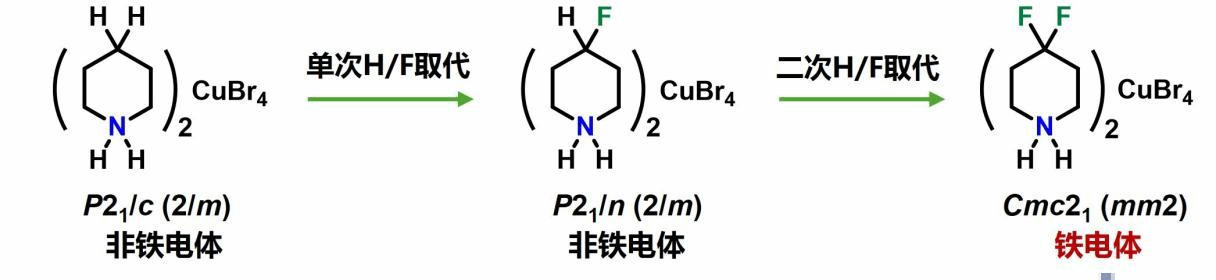
Figure 1. Ferroelectricity of (4,4-difluoropiperidinium)2CuBr4 realized by secondary H/F substitution.
The primary TOFU effect (H/F substitution strategy) is one of the important design principles in ferroelectrochemistry. Similar to the H/D isotope effect, it exhibits wider applicability. Since the Pauling radius of the F atom is close to that of the H atom, replacing H atoms with F atoms generally does not significantly alter the crystal packing, so the crystal point group can often remain unchanged, analogous to the H/D isotope substitution effect. As shown in Figure 1, after primary H/F substitution of the H atom at the 4-position of the piperidinium organic cation in the non-ferroelectric parent compound (piperidinium)2CuBr4, the crystal point group (2/m) of the resulting compound (4-fluoropiperidinium)2CuBr4 remains unchanged, similar to the H/D isotope effect.
Notably, there is another H atom at the 4-position of the piperidinium organic cation. Upon secondary H/F substitution, the crystal symmetry and intermolecular interactions can be further modified at the molecular level, thus realizing the targeted design of ferroelectricity. As shown in Figure 1, the two-dimensional mixed tetrahedral–octahedral hybrid perovskite (4,4-difluoropiperidinium) 2CuBr4 obtained via secondary H/F substitution exhibits enhanced molecular symmetry. However, the intermolecular interactions introduced by multi-fluorine substitutions modify the crystal packing, leading it to crystallize in the non-centrosymmetric polar point group mm2 at room temperature. The 4,4-difluoropiperidinium organic cations are arranged in an ordered orientation in the crystal, generating macroscopic ferroelectric polarization, thereby successfully realizing ferroelectricity in this two-dimensional hybrid perovskite.
In summary, the primary TOFU effect is similar to the isotope effect, whereas the secondary TOFU effect can modify crystal symmetry and effectively induce the formation of non-centrosymmetric structures. Academician Kian Ping Loh, Fellow of the Singapore National Academy of Sciences (SNAS) and Academician Wenping Hu, Member of the Chinese Academy of Sciences (CAS), together with their teams, applied this concept to design and synthesize two-dimensional mixed tetrahedral–octahedral hybrid perovskite ferroelectrics, and their work was published in Nature Synthesis. This indicates that the multi-fluorine substitution effect plays a significant role in the precise design of molecular ferroelectrics, and will be more widely applied in more molecular ferroelectric material systems.