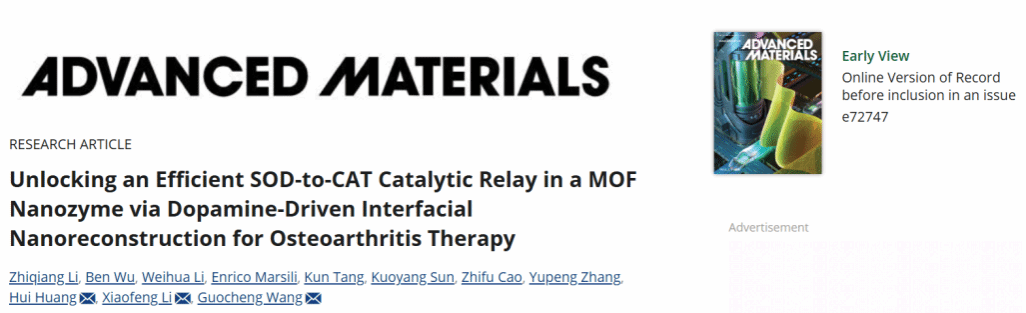
Recently, the research team led by Professor Li Xiaofeng from the Department of Orthopedics at the First Affiliated Hospital of NCU published an original research article titled “Unlocking an Efficient SOD-to-CAT Catalytic Relay in a MOF Nanozyme via Dopamine-Driven Interfacial Nanoreconstruction for Osteoarthritis Therapy” in Advanced Materials (CAS Q1, TOP Journal, IF=26.8). This study proposes an innovative “pre-intercalation/activation” strategy to construct a ZIFZn/Co@PDA nanozyme by nanoscale interfacial engineering. This work provides a novel strategy for developing potential disease-modifying osteoarthritis (OA) drugs (DMOADs) and offers new insights into designing sophisticated catalytic nanozymes.
What are the Limitations of Traditional OA Therapies?
The pathological core of OA lies in the vicious cycle formed by inflammation and the accumulation of reactive oxygen species (ROS). While cobalt-based metal-organic framework (MOF) nanozymes are potent catalase (CAT) mimics, their therapeutic efficacy is limited by an inherently weak superoxide dismutase (SOD)-like activity that prevents full-chain ROS scavenging.
The Construction of a New Nanozyme Provides an Innovative Strategy for OA Therapy
To resolve this problem, the team proposed an innovative “pre-intercalation/ activation” strategy to construct a ZIFZn/Co@PDA nanozyme by nanoscale interfacial engineering, unlocking an efficient SOD-to-CAT catalytic relay. The powerful ROS-scavenging capability of the ZIFZn/Co@PDA nanozyme restores mitochondrial function and effectively reprograms macrophages, thereby achieving both cartilage protection and pain relief. This study provides a novel approach for the development of potential disease-modifying OA drugs (DMOADs) and provides new insights into the design of sophisticated catalytic nanozymes.
Dr. Li Zhiqiang and Dr. Li Weihua from the Department of Orthopedics at the First Affiliated Hospital of NCU, along with Dr. Wu Ben from the Shenzhen Institutes of Advanced Technology (SIAT) of the Chinese Academy of Sciences, are the co-first authors of this paper. Professor Li Xiaofeng from the First Affiliated Hospital of NCU, Professor Wang Guocheng from the Shenzhen Institutes of Advanced Technology (SIAT) of the Chinese Academy of Sciences, and Professor Huang Hui from the Eighth Affiliated Hospital of Sun Yat-sen University are the co-corresponding authors.