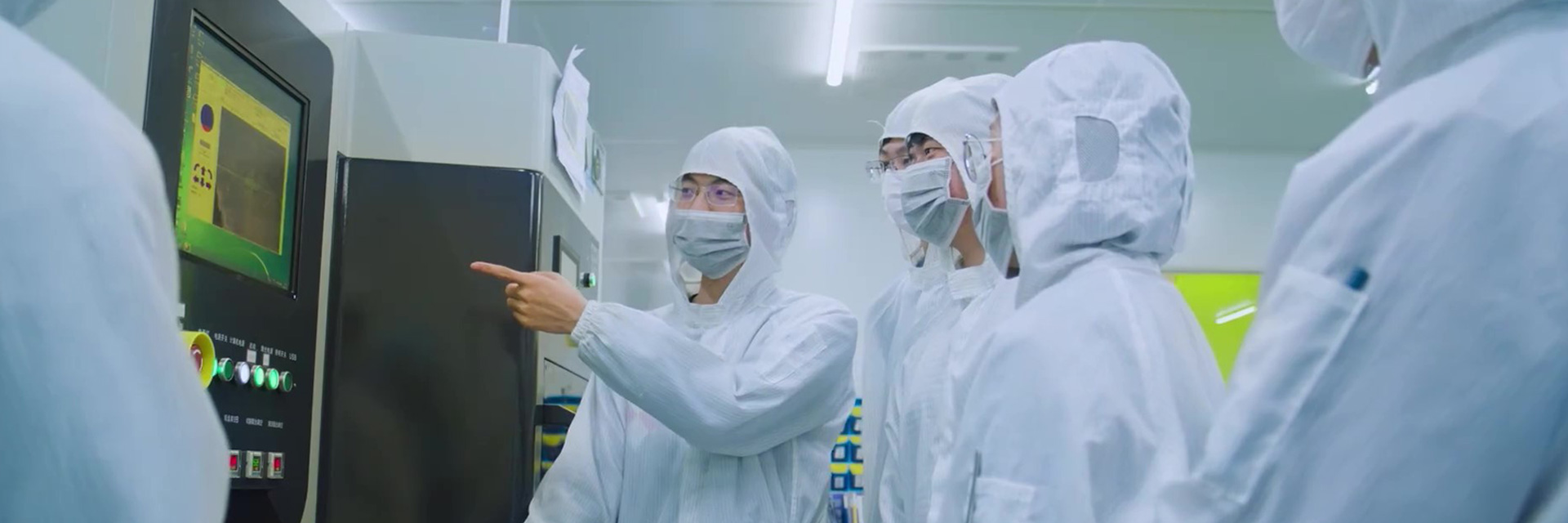
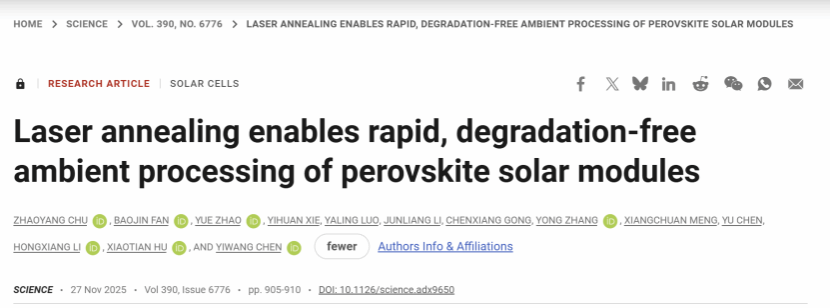
Recently, a research team led by Professor Chen Yiwang and Professor Hu Xiaotian from the School of Chemistry and Chemical Engineering and the Institute of Polymers and Energy Chemistry at Nanchang University (NCU) has achieved a significant breakthrough in novel thin-film solar cell technology. Their findings have been published in the prestigious journal Science with the title “Laser annealing enables rapid, degradation-free ambient processing of perovskite solar modules.” This research innovatively proposed and realized a laser annealing technique that can be performed in an ambient environment, providing a critical scientific basis and technological approach for the large-scale, low-cost, and highly stable fabrication of perovskite photovoltaic materials.
This research was led by Nanchang University, in collaboration with Jiangxi Normal University, Guang'an Institute of Technology, and the Yangtze Delta Institute of Optoelectronics of Peking University. Doctoral student Chu Zhaoyang from Nanchang University and Dr. Fan Baojin from Jiangxi Normal University are the co-first authors of the paper. Professor Chen Yiwang, Professor Hu Xiaotian (both from Nanchang University), and Dr. Li Hongxiang from Guang'an Institute of Technology are the corresponding authors.
Perovskite solar cells are considered the most promising next-generation photovoltaic technology due to their high-power conversion efficiency and solution processability. However, conventional thermal annealing requires prolonged processing in an inert atmosphere, posing a major challenge for high-throughput production. Through in situ grazing-incidence wide-angle X-ray scattering analysis, the research team revealed for the first time a four-stage degradation mechanism during thermal processing and identified a 123 ± 18-second ambient, degradation-free window. Based on this discovery, the team developed a high-power blue laser annealing system (455 nm wavelength, 20 W cm⁻⟡). This technique enables rapid crystallization of large-area films within 20 seconds, during which the detrimental effects of water and oxygen are mitigated. This achievement yields a new high-throughput, low-energy-consumption, and environmentally friendly fabrication approach for perovskite photovoltaics, breaking away from the traditional reliance on inert environments. It offers critical technological support for transitioning the fabrication of high-efficiency photovoltaic materials in China from laboratory research to industrial-scale application.
This study received support from the National Key Research and Development Program of China, the National Natural Science Foundation of China (NSFC), the Natural Science Foundation of Jiangxi Province, and other programs. The results underscore NCU’s role in supporting Jiangxi Province’s “1296” Action Plan through fundamental research, thereby helping to cultivate the new energy industry. They also offer substantial scientific and technological support for building Jiangxi into a national hub for advanced photovoltaics.