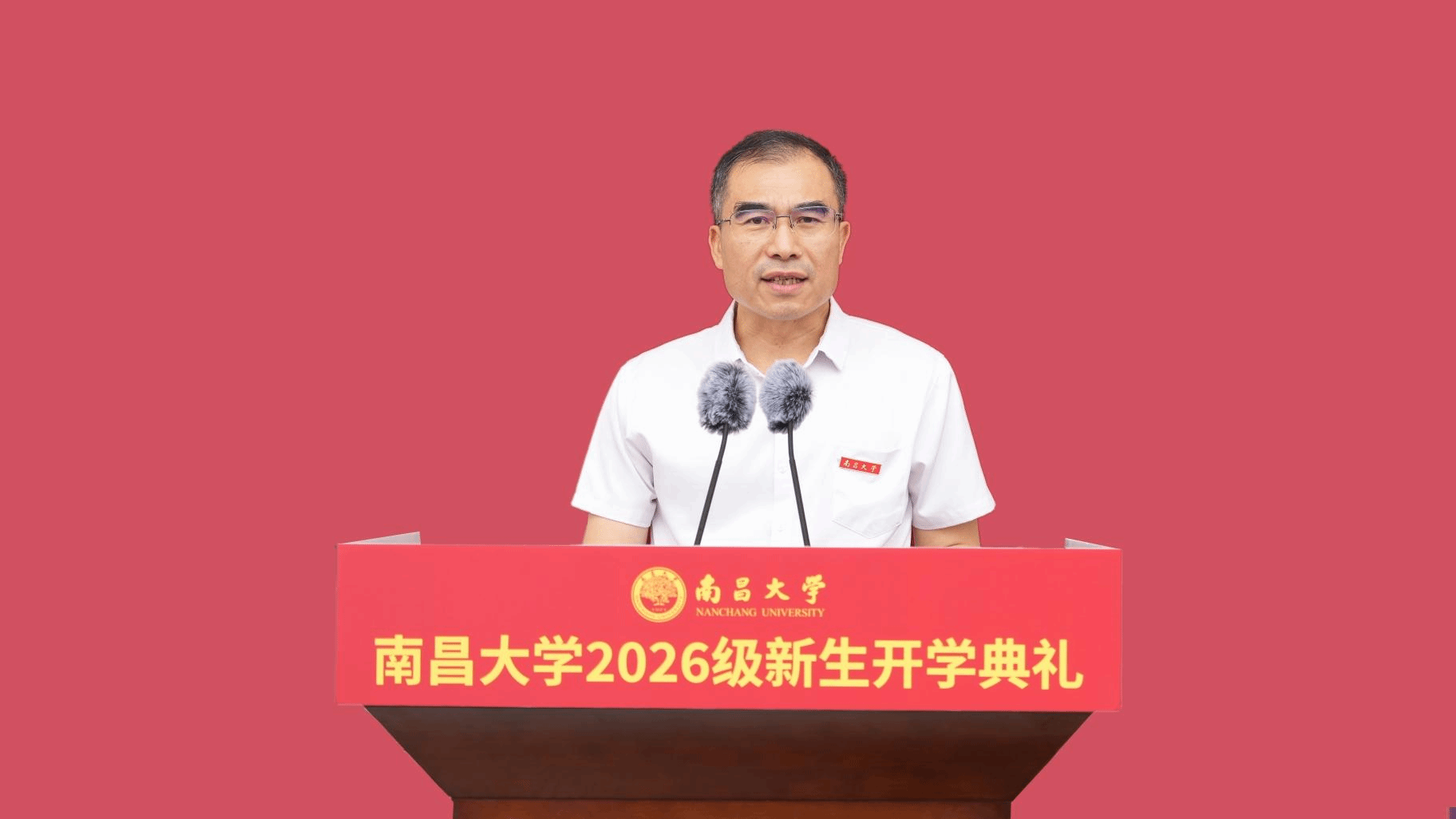
The Way of Scholarship: Learn Extensively, Inquire Accurately, Reflect Prudently, Discern Clearly, and Practice Earnestly
— Speech at the Opening Ceremony for New Students of 2026
Chen Yeguang, President of Nanchang University
Dear new students of 2026:
Good morning!
Today, we gather here for the Opening Ceremony for New Students of 2026. On behalf of every member of the faculty and staff, I extend our warmest welcome and most sincere congratulations to each of you, the new students of 2026. My heartfelt thanks also go to your parents and teachers, who have nurtured and guided you with such unwavering dedication.
When you filled out your college application forms, you may have learned something about Nanchang University, though perhaps not in depth. Have you noticed the pattern on our university emblem? It depicts a lush camphor tree. Deep-rooted and evergreen, it stands tall and unshaken through wind and rain. It embodies the spirit of this century-old university and mirrors the educational ideal that “it takes ten years to grow trees, but a hundred years to cultivate people”. You are the fresh shoots sprouting from this time-honored camphor tree. Here you will put down roots and grow upward. Your arrival has brought the brightest hues and the most vibrant energy to our century-old university.
Nanchang University was born in a time of national crisis and grew as the nation rose. In 1921, patriots including He Huankui, driven by the aspiration to "relieve human suffering, benefit the people, cultivate outstanding talents and serve their hometown", founded Jiangxi Public Medical School, pioneering modern medical education in the province. In 1940, at a critical moment for the nation, the renowned botanist Hu Xiansu was entrusted with founding National Zhongzheng University in Taihe, Ji'an, which became one of the 19 national comprehensive universities of the time. In 1958, Jiangxi University and Jiangxi Industrial College (the predecessor of Jiangxi Industrial University) were established, filling long-standing gaps in the province's higher education, which had previously lacked both a comprehensive university and dedicated engineering institutions. In 1993, the two merged to form Nanchang University. Academician Pan Jiluan returned from Tsinghua University to his hometown to serve as president, and under his leadership the university was included in the national "Project 211" key-construction program, ending Jiangxi's long-standing 'Three Nos' — no academicians, no doctoral programs, and no nationally designated key universities. In 2005, Jiangxi Medical College was merged into Nanchang University, giving the university a complete disciplinary landscape spanning the liberal arts, sciences, engineering and medicine. Through more than a century of change, the university has always shared the destiny of the nation and kept pace with the times.
Guided by its motto of “Seeking Truth and Innovation, Cultivating Virtue and Benefiting People”, the university upholds the educational philosophy of “putting people first, prioritizing morality and valuing scholarship”. At present, Nanchang University is forging ahead toward its goal of building a world-class university rooted in Jiangxi with Chinese characteristics. Starting today, you will embark on a brand-new journey here. Facing a future brimming with infinite possibilities, every one of you must earnestly reflect on how to find your direction, build up your strengths and pursue your dreams during your university years.
The greatness of a university lies not in its sprawling campus, towering buildings or large student body, but in its distinguished scholars and depth of scholarship, its breadth of vision and openness of mind, and — above all — in the lofty ideals of its students and the far horizons they will reach. University study is also different from high school education, which centers on absorbing knowledge and forming good habits; the university centers on mastering the methods of scholarship, cultivating a scholarly spirit, and shaping an independent mind. So going to university is not merely about how much you memorize or what scores you achieve — it is about learning how to learn, how to think, how to judge, and how to act. In the Doctrine of the Mean, a chapter in The Book of Rites, this way of scholarship is distilled into fifteen Chinese characters: "Learn Extensively, Inquire Accurately, Reflect Prudently, Discern Clearly, and Practice Earnestly." These fifteen characters trace a complete arc of scholarship — from broad acquisition to questioning and reflection, from deep deliberation to clear discernment, and finally to earnest practice. That is the theme of my address today.
Learn extensively: I hope you will break down boundaries and pursue knowledge broadly, laying a solid foundation for growth with a broad vision. Broad knowledge underpins personal growth and success. In this era of rapid technological advances, traditional single-discipline knowledge structures can hardly address the major challenges of our time, rendering interdisciplinary integration indispensable. A series of major scientific and technological breakthroughs have all emerged from interdisciplinary integration, such as the artificial sun—EAST (Experimental Advanced Superconducting Tokamak), the Jiuzhang 4.0 photonic quantum computing prototype, and the clinical application of the “Beinao-1” brain-computer interface system ...
The university opens up a boundless intellectual world for you. Nanchang University offers a full range of disciplines spanning the humanities, sciences, engineering and medicine. Materials Science and Engineering, our national "Double First-Class" discipline, continues to make breakthroughs; Food Science and Engineering ranks among the top programs in the country; Chemistry, Engineering, Medicine and a number of other disciplines are also gaining strength rapidly. Here you will find a well-stocked library, advanced laboratory facilities, micro-major programs, interdisciplinary course clusters, an "AI + interdisciplinary" curriculum, and an academic ecosystem that integrates the humanities, sciences, engineering and medicine — a wide-open platform for you to break down disciplinary boundaries and learn across fields.
During your university years, you should not only do well in your major coursework, but also take the initiative to step beyond the classroom — attend a lecture, read a classic, enjoy a painting, explore the applications of artificial intelligence, and much more. Hu Xiansu was not only a founder of modern Chinese botany and the discoverer of the dawn redwood, which is celebrated as a "living fossil", but also a scholar deeply versed in both Chinese and Western learning. He pursued truth in science while cultivating his mind through the humanities, bridging the arts and sciences and the ancient and the modern. In June this year, students in the inaugural experimental class co-run by the university and Advanced Micro-Fabrication Equipment Inc. completed a full journey from chip design to tape-out and delivery by drawing on knowledge from mechanics, electronics, materials and other disciplines. I hope you will step out of your "learning comfort zone" and refuse to be confined by disciplinary walls or self-imposed limits. While deepening expertise in your own field, explore other disciplines widely, strengthen your humanistic literacy, and build a varied, cross-disciplinary knowledge base to underpin your future growth.
Inquire accurately: I hope you will dare to question and keep probing, exploring the essence of things with a truth-seeking spirit. Getting to the root of a question and uncovering its essence is at the heart of all scholarly inquiry. The university no longer settles for "standard answers"; it encourages you to question, to investigate, to challenge and to get to the bottom of things. Keep an inquiring mind — do not passively accept what you hear in class, but ask "why" again and again. Especially in this AI era, knowledge is more accessible than ever, yet easy access is not the same as deep comprehension, and receiving information is not the same as mastering it. AI tools can produce a seemingly complete analysis or solution in seconds, but if you do not question whether the logic is sound and the data reliable, you remain a passive receiver of information rather than the true owner of the knowledge.
When Academician Jiang Fengyi of our university took on silicon-substrate LED technology, he faced a widespread international consensus that "this path would not work". Refusing to follow prevailing opinion, he kept asking: Why is it deemed unworkable? Are there possibilities we have overlooked? Driven by this spirit, he and his team blazed a third technical path and won the First Prize of the State Technological Invention Award in 2015. In July this year, Academician Jiang Fengyi's team achieved another major scientific breakthrough, as its project "V-Defect Three-Dimensional PN Junctions and Their Applications" won the First Prize of the State Natural Science Award in 2025. Their journey shows that true innovation begins with questioning what is taken for granted, and is realized only through unwavering inquiry.
Dear students, the university is a place that embraces questions and tolerates trial and error. Do not fear asking naive questions, nor worry about being ridiculed. I hope you will develop the habit of questioning and inquiring, and boldly pursue truth and explore the essence of reality.
Reflect prudently: I hope you will settle your mind, put down deep roots, and forge independent personalities through patient, sustained effort. To settle your mind and put down deep roots means avoiding blind conformity, impetuosity and herd mentality, and forming your own judgments and convictions. Through wide learning and deep thinking, you can hone your thoughts to a fine edge in quiet reflection. In this era of information explosion, we are flooded with news feeds, short videos and fragmented knowledge. What algorithmic feeds tend to deliver is what you are likely to "like" — not what you actually need. What dominates public discourse is too often emotion rather than fact. In such an environment, the willingness to slow down and think for yourself matters more than ever.
Such independent judgment is not far away; it shows up in your everyday life on campus. When course selection opens and you see fellow students rushing for "popular" courses, do you pause and ask yourself: what do I really want to learn? When classmates chase high GPAs and certificates, and your social feed is full of anxiety about "landing a stable job" or the much-debated "involution" (the runaway rat-race competition), do you ever ask: should my pace be set by others? When a viral topic sweeps across social media and everyone seems to be commenting and sharing posts, can you hold back the urge to weigh in, verify the facts, and consider whether there is another side to the story? When you face a career choice and the voices around you insist that "this is the safe bet", can you stop, think carefully, and arrive at a choice that is truly your own?...
Dear students, your university years are a critical period of intellectual and moral growth. When faced with an opinion, I urge you not to rush to respond, but to examine the logic behind it. When faced with a trend, do not rush to follow, but ask whether it is worth following. When faced with a way of life, do not rush to imitate, but ask whether it suits you. Amid the clamor of many voices, learn to hear your own heart clearly; amid the noise and restlessness of the moment, keep your composure. With a settled mind, forge an independent character and a mind that is free.
Discern clearly: I hope you will tell right from wrong and remain steadfast, calibrating the course of your life with sound judgment. At university you will encounter a wide variety of perspectives, values and ways of life. You will find that many questions cannot be measured by a single yardstick. Do not share online information casually; always ask yourself, "Is this true?" Some arguments sound reasonable yet hide a bias. Some choices look tempting yet may turn out to be the wrong path in the long run. Building your own framework of judgment in a pluralistic world of values is a challenge you must take on as you grow.
General Secretary Xi Jinping once encouraged young people: “In the face of profound global changes, you must distinguish right from wrong, hold fast to the right path, and neither echo others nor follow trends blindly.” In an environment where truth and falsehood are hard to tell apart, and when interests clash with morality, it is critical to hold the line and keep your bearings. What is good, what is evil, what ought to be done and what must never be done — these seemingly simple questions severely test your resolve amid complex realities.
Life presents countless choices, and you must weigh what matters and know what to embrace and what to let go. After completing his studies in Japan and returning to China, Mr. He Huankui could have practiced medicine and lived a life free from financial worries. Yet, weighing his own interests against the greater good, he chose to devote himself to medical education and founded Jiangxi Public Medical School. Such wholehearted commitment to the nation’s cause is worth pondering for a lifetime.
Dear students, the university years are a formative phase for shaping your worldview, outlook on life and values. I hope you will develop your own set of criteria through thorough reflection. At life’s crossroads, do not drift with the tide. Know clearly what is right, what is worthwhile and what you ought to uphold. Keep asking yourself: What do I truly want? What does society need from me? Clear discernment does not mean you will never make mistakes. It means that reason and conscience will guide you in every choice you make.
Practice earnestly: I hope you will persevere without slackening, stay down-to-earth, and write a brilliant chapter of your youth through solid action. Earnest practice is the only bridge to realizing your dreams. No matter how lofty your ideals, they can only be realized through steady, step-by-step progress. All learning, reflection and judgment can realize their value only when translated into down-to-earth action.
You have grown up in an era of knowledge explosion and ever-accelerating technological change. You may not lack information, platforms or resources. What really counts, however, is the ability to turn ideas into reality. During your university years you will have countless ideas and plans — to learn a new skill, enter a competition, do volunteer work, start a business, pursue a master's degree, and much more. What ultimately sets people apart is not who has the most brilliant ideas, but who can act, and keep acting over the long haul.
Dear students, as the old saying goes, "Though the road may be short, it cannot be reached without walking; though a task may be small, it cannot be accomplished without action." Do not be idle dreamers content merely to "lie flat"; be practical doers who take real, concrete action. Begin with paying close attention in every class, completing every experiment on your own, finishing every morning run, and taking part actively in every act of volunteer service. Break grand blueprints into specific daily actions, and translate lofty goals into the careful handling of every small task.
This year marks the 105th anniversary of our university. Over the past 105 years, generations of NCUers have nourished their dreams through extensive study, sought truth through earnest inquiry, refined their character through quiet reflection, anchored their direction through sound discernment, and achieved glory through steadfast practice — jointly forging the NCU spirit of “Patriotism, Self-reliance, Innovation and Practicality”. Here, I hope you will acquire not only the knowledge and skills to make your way in the world, but also a calm, profound bearing and a broad vision.
Dear students, may you live up to your era and your youth, and write brilliant new chapters of your own through earnest scholarship!
I wish you all academic success, good health, and happiness!
Thank you!